
No question generates more heated debate on r/FulfillmentByAmazon and r/AmazonSeller than this one: should we hire an Amazon agency, build an in-house team, or invest in an AI-powered operating system? The community has been having this argument since 2019, and in 2026 the parameters have shifted significantly — primarily because AI operating systems have matured from experimental technology to production-ready infrastructure that mid-market brands can actually access.
This article synthesises 18 months of community discussion into a structured decision framework — not an opinion piece about which model is theoretically best, but a practical guide to which approach produces the best outcome for which brand at which stage of growth. We will cost-model all three, summarise what Reddit actually says about each, and provide the decision criteria that should drive your choice.
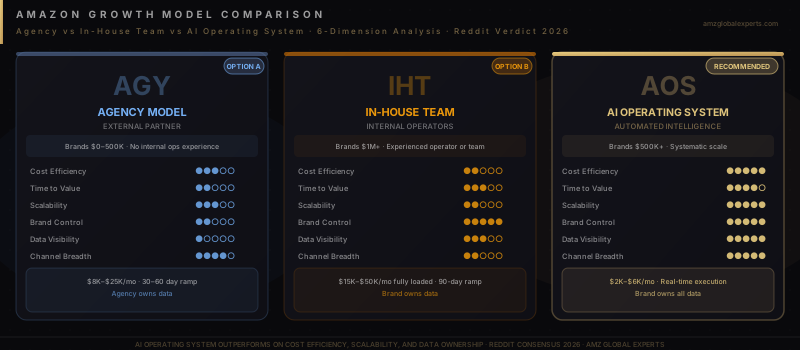
Model 1: The Amazon Agency
Cost Structure
Agency cost depends heavily on scope and tier. For a mid-market brand ($1M–$5M Amazon revenue) engaging a reputable mid-tier agency for comprehensive account management (PPC management, listing optimisation, A+ content updates, and monthly strategy review), expect $6,000–$15,000/month in agency fees plus PPC ad spend. Total annual cost including agency fees and a typical $30,000–$60,000/month ad budget: $432,000–$900,000. Agency fees represent $72,000–$180,000 of this total.
What Reddit Says
Agency sentiment on Reddit is more nuanced than a simple positive/negative split. The community's most consistent finding: agencies deliver the most value in the first 6–12 months of engagement, when they are setting up account structure, cleaning up historical campaign issues, and applying expertise the brand genuinely does not have internally. After 12–18 months, experienced community members frequently report that the incremental value of the agency drops — because the brand team has learned enough from the agency to replicate most of what they provide, and the agency relationship has stabilised into a maintenance mode that may not justify the ongoing fee level.
The community's specific praise for agencies centres on speed to value: for a brand that has never run Amazon PPC, a good agency with category experience can achieve in 60–90 days what would take an inexperienced in-house hire 9–12 months to learn. The community's specific criticism centres on dependency: brands that rely on agencies for too long tend to build no internal Amazon capability, making them vulnerable to agency price increases, account manager turnover, and the negotiating disadvantage of having no alternative if the relationship deteriorates.
Best For
- Brands new to Amazon without internal PPC expertise
- Brands with $500k–$3M Amazon revenue needing rapid capability deployment
- Brands with limited internal bandwidth for campaign management
- Brands launching in a new Amazon market (international expansion)
Model 2: The In-House Team
Cost Structure
An in-house Amazon team for a mid-market brand typically requires: an Amazon Account Manager ($70,000–$95,000/year), a PPC Specialist ($65,000–$90,000/year), and a Listing/Content Specialist ($55,000–$75,000/year). Total salary cost: $190,000–$260,000/year, plus benefits, tools (Helium 10, Jungle Scout, DataDive: $15,000–$25,000/year), and management overhead. All-in annual cost: $220,000–$310,000 before ad spend — comparable to a mid-tier agency relationship at similar scale.
What Reddit Says
The in-house model receives the most unambiguously positive community sentiment — but only from brands that have successfully built a high-quality team. The community's consensus: in-house teams that have been operating for 18+ months consistently outperform agencies on brand-specific strategy, catalogue management depth, and responsiveness. The disadvantage is the 9–18 month ramp-up period during which performance is typically lower than what an experienced agency would achieve immediately.
The community's most consistent warning about in-house teams: the Amazon talent market is competitive, and the difference between an excellent in-house PPC specialist and an average one can be 30–50% in campaign efficiency — a gap that is difficult to identify during hiring. Brands that have hired poorly and then struggled to replace under-performers generate a significant proportion of "we tried in-house and it didn't work" threads. The community advice: hire slowly, test candidates with a structured audit task before full engagement, and budget for 60–90 day performance ramp-ups.
Best For
- Brands above $3M Amazon revenue where agency fees exceed the cost of equivalent in-house capability
- Brands with complex catalogues requiring deep institutional knowledge
- Brands where brand voice and strategic control are paramount
- Brands with the internal HR infrastructure to recruit and retain specialised Amazon talent
Model 3: The AI Operating System
Cost Structure
AI operating system pricing varies by provider and scope — but the critical distinction from the other two models is channel breadth. An AI operating system manages Amazon, Shopify, TikTok Shop, and international marketplaces simultaneously, from a unified data layer. The cost is not simply an Amazon spend — it replaces the aggregate cost of a fragmented agency-per-channel arrangement. Brands that were previously paying $6,000–$12,000/month for an Amazon agency, $3,000–$5,000/month for a Shopify CRO agency, and $4,000–$8,000/month for a social commerce manager are paying $13,000–$25,000/month for fragmented channel management across 3 relationships. An AI operating system replaces all three with one unified architecture, typically at a comparable or lower total cost.
What Reddit Says
Discussion of AI operating systems on Reddit is more nascent than agency or in-house debate — the category is newer and community experience is still accumulating. The threads that do exist reveal consistent themes: brands that have adopted AI operating systems are uniformly positive about data visibility (real-time cross-channel attribution that fragmented arrangements cannot provide) and scalability (adding a new channel or market without adding headcount). The community's caution is around transition risk: brands that switch from a functioning agency relationship to an AI OS without adequate transition planning have experienced temporary performance dips during the migration of campaign structures.
The Reddit community increasingly distinguishes between AI tools (software that automates specific tasks) and AI operating systems (infrastructure that replaces the entire operational layer). Community members who have evaluated both note that true operating systems — those that provide real-time cross-channel data, unified attribution, and AI-driven campaign management simultaneously — are qualitatively different from adding AI tools on top of a fragmented stack.
Best For
- Brands above $1M revenue operating (or planning to operate) on 3+ channels simultaneously
- Brands where cross-channel attribution clarity is a strategic priority
- Brands scaling internationally where managing separate agency relationships per market is operationally unsustainable
- Brands that have outgrown their current agency but are not ready to build a full in-house team
The Decision Framework
| Criterion | Agency | In-House | AI OS |
|---|---|---|---|
| Speed to value | 60–90 days | 9–18 months | 60–90 days |
| Amazon annual cost (excl. ad spend) | $72k–$180k | $190k–$310k (3 hires) | Comparable (replaces 3+ agencies) |
| Channel breadth | 1–2 platforms | 1–2 platforms | All channels unified |
| Brand control | Low | High | High |
| Data visibility | Agency-controlled | Internal only | Real-time, unified |
| Scalability | Linear cost increase | Linear headcount increase | Non-linear — system scales |
| Reddit community sentiment | Mixed | Positive (when done well) | Positive (growing data set) |
The Reddit verdict synthesised: Use an agency when you need speed and lack expertise. Build in-house when you have reached $3M+ Amazon revenue and need deep institutional knowledge. Adopt an AI operating system when your constraint is not channel-specific expertise but cross-channel coordination — when you need Amazon, Shopify, TikTok Shop, and international markets to function as one revenue engine rather than competing budget allocations managed by separate teams.
Frequently Asked Questions
Reddit's consensus: agencies deliver faster time-to-value and are superior for brands under $2M Amazon revenue or brands new to the platform. In-house teams outperform over a 2–3 year horizon for brands above $3M revenue, where the depth of catalogue knowledge and brand-specific strategy compounds in ways agencies cannot replicate. The transition point — where in-house ROI surpasses agency ROI — typically occurs at $2M–$3M Amazon revenue.
An AI operating system connects all channels (Amazon, Shopify, TikTok Shop, marketplaces) to a single real-time data layer, applying AI-driven campaign management, inventory coordination, and attribution modelling across all channels simultaneously. The key difference from an agency or tool: it replaces the entire operational layer rather than adding a service on top of a fragmented stack, eliminating the data inconsistency and attribution confusion that multi-agency arrangements produce.
The top-voted advice: demand full account access at all times (never accept agency-only access), ask for direct reference calls in your specific category, require a 90-day trial period before long-term commitment, and insist on a clear exit clause that transfers all campaign structures and creative assets on departure. For AI operating systems: ask for a data architecture walk-through showing exactly how channels connect and how attribution is calculated.
The Reddit community's consistent benchmark: evaluate the transition at $2M–$3M Amazon revenue. At this level, agency fees ($72k–$180k/year) begin to approach the cost of equivalent in-house capability, and the brand typically has enough operational complexity that deep institutional knowledge (in-house) or unified cross-channel management (AI OS) creates more value than the external expertise the agency provides.