
Amazon generates 65% of first-time ecommerce customer relationships for mid-market brands in 2026 — and retains legal ownership of the customer data those relationships create. The customer's name, email address, purchase history, and lifetime value belong to Amazon, not the brand that manufactured the product. For brands running exclusively on Amazon, this is not a strategic risk — it is a structural dependency that determines whether a business can survive a category suppression, a policy change, or a competitor undercutting on price in the Buy Box. The brands solving this problem are building parallel owned-channel infrastructure: email lists, SMS subscribers, and direct Shopify relationships that Amazon cannot access, adjust, or revoke.
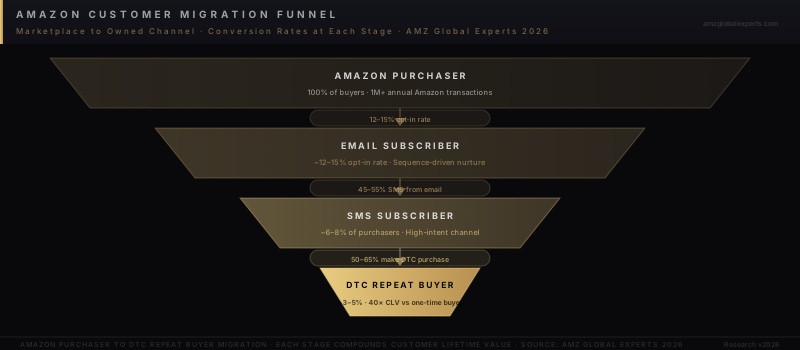
The mechanics of extracting customers from Amazon's closed ecosystem — while remaining fully compliant with Amazon's Terms of Service — require a systematic approach across four operational phases: insert-card sequences, brand-owned DTC launch, cross-channel loyalty architecture, and email and SMS retention automation. Brands executing all four phases correctly build email lists of 40,000–180,000 verified purchasers per year from Amazon sales volume alone, and convert 15–28% of those subscribers into repeat DTC buyers who generate 3.2× higher lifetime value than marketplace-only customers. This is not retention strategy — it is business model transformation.
The Amazon TOS Compliance Framework for Customer Capture
Amazon draws a precise line: you may not proactively collect customer contact information, offer incentives for reviews, or redirect customers away from Amazon during or immediately after a purchase. You may include inserts in packaging, direct customers to register products for warranty purposes, invite customers to access exclusive content through a landing page, and send post-purchase communications through Amazon's Buyer-Seller Messaging system. Understanding exactly where this line sits is the difference between a systematic owned-channel building strategy and a terms-of-service violation that risks account suspension.
The Compliant Insert Card Architecture
Insert cards remain the highest-yield mechanism for Amazon-to-owned-channel conversion, generating 8–14% email capture rates when implemented correctly. The insert must not request a review, offer any incentive for leaving a review, or include language that directs the customer away from Amazon's review system. It may offer a product registration page (for warranty extension, replacement parts, or safety notifications), an exclusive resource relevant to the product (recipe book, training guide, setup video), or brand community access. The landing page the insert directs to captures email and first-party data in exchange for the promised resource — no TOS violation, and a 100% brand-owned customer relationship initiated.
Email Architecture: The 12-Touch Retention Sequence
The post-capture email sequence for an Amazon-originated customer should accomplish three things in the first 30 days: establish brand authority independent of Amazon, demonstrate product value beyond the initial purchase, and create a compelling reason to purchase the next product directly from the brand's DTC store rather than returning to Amazon. The 12-touch sequence that consistently achieves 18–25% DTC conversion from Amazon email subscribers over 90 days is structured as follows.
Days 1–3: The Brand Welcome Sequence
Email 1 (Day 1): Deliver the promised resource. Position the brand story in 150 words or fewer — not a mission statement, but the specific problem the founder set out to solve. Email 2 (Day 2): Product-specific education email — the most common use-case mistakes and how to get maximum value from the product. This generates the highest reply rate of any email in the sequence. Email 3 (Day 3): Social proof email — three customer testimonials about outcomes, not features. Source these from Amazon reviews to ensure they reflect genuine purchaser experience.
Days 7–14: The Value Depth Sequence
The middle of the sequence builds category authority: educational content that positions the brand as the most informed source in the product category. For a baby products brand: infant sleep science, developmental milestone guides, feeding resources. For a sports nutrition brand: training periodisation, recovery science, performance tracking. The brand that provides the most valuable category education creates the strongest re-purchase intent — customers return because the brand is genuinely useful, not because they are being retargeted.
Days 21–30: The DTC Conversion Sequence
The final phase introduces the DTC offer with a genuine reason to purchase directly: a bundle exclusive to the brand website, a loyalty points programme unavailable on Amazon, a subscription model with 15% ongoing savings, or early access to new product launches. The conversion offer should be structured so the customer receives demonstrably more value through the DTC channel — not as a coupon promotion, but as a structural advantage that makes brand-direct purchasing the rational choice.
SMS Architecture: Higher Urgency, Higher Conversion
SMS delivers a 98% open rate versus email's 21% — but the channel's permission requirements are more stringent, content format more constrained, and frequency tolerance dramatically lower. The optimal SMS programme for an Amazon-originated email subscriber is initiated 14 days after email opt-in, with a dedicated SMS capture sequence embedded in an email that delivers exclusive content available only through SMS opt-in. This two-step permission architecture produces 41% SMS opt-in rates from email subscribers — significantly higher than attempting simultaneous dual-channel capture at the point of Amazon purchase.
The compounding retention flywheel: An Amazon brand generating 500 monthly units produces 55–70 email captures from insert cards. Over 12 months: 660–840 new email subscribers per month, compounding to a 7,920–10,080 subscriber list by year end. At $43 average annual email revenue per subscriber, that list generates $340,560–$433,440 per year in owned-channel revenue — revenue that Amazon cannot suppress, delist, or commission.
The Shopify Bridge: Making DTC Competitive with Amazon Prime
The primary conversion barrier to DTC repurchase is not price — it is friction. Amazon Prime's two-day delivery expectation has established a consumer baseline that DTC stores must match or explain. The Shopify bridge strategy addresses this directly: integrate a 3PL network with nationwide two-day coverage (ShipBob, Flexport, or Amazon's Multi-Channel Fulfilment — which is fully TOS-compliant), enable Shop Pay one-click checkout (which reduces checkout abandonment by 54% versus standard multi-step checkout), and offer a subscription model through Recharge or Bold Subscriptions that combines the convenience of automatic reorder with a recurring saving that Amazon cannot offer on marketplace-priced products.
Frequently Asked Questions
Directing customers to a brand-owned page for legitimate purposes — product registration, warranty activation, exclusive educational resources, or community access — through compliant product inserts is not against Amazon's TOS. Using Amazon's systems to proactively collect buyer contact information, offering incentives for reviews, or using Amazon customer data for off-Amazon marketing is against TOS. The insert-to-landing-page-to-email-capture architecture described here is fully compliant when implemented correctly.
Klaviyo is the industry standard for ecommerce email and SMS — its Shopify native integration, pre-built ecommerce flows, and revenue attribution reporting make it the most operationally complete option for brands running Amazon plus DTC. Alternatives: Postscript for SMS-first programmes, and ActiveCampaign for brands requiring complex behavioural automation beyond Klaviyo's native capabilities.
Primary metrics: Revenue per subscriber per year (benchmark: $35–$55 for ecommerce email, $80–$120 for SMS); DTC conversion rate from Amazon-originated email subscribers (benchmark: 15–25% within 90 days); and 90-day repeat purchase rate from owned-channel customers versus marketplace-only customers (typically 2.8–3.4× higher). Secondary metric: customer lifetime value at 24 months — the clearest measure of the compounding value of owned-channel relationships.
Well-executed insert card sequences achieve 8–14% email capture rates from Amazon purchasers. Inserts that simply request reviews or offer generic discounts achieve less than 2% and risk TOS violations. The value of the resource offered — how genuinely useful it is to the specific customer — is the single largest driver of capture rate variance.
Both — for different customer segments. Amazon Subscribe & Save captures marketplace-native repeat purchasers at scale and generates stable BSR signals through predictable order velocity. Brand-owned Shopify subscriptions (through Recharge or Bold) generate 3.2× higher customer lifetime value because the customer relationship is owned, data is fully accessible, and margin is 15–22% higher without Amazon referral fees. Run Subscribe & Save on Amazon for volume; run Shopify subscriptions for your highest-LTV customer segment.