
In March 2024, a 34-year-old former accountant from Phoenix posted a screenshot to r/FulfillmentByAmazon. His supplement brand had just crossed $2.1 million in trailing-twelve-month revenue. His gross margin: 71 percent. His PPC spend as a percentage of revenue: 9 percent. He had built the business in three years with no outside investment, no warehouse, no employees beyond two virtual assistants. The community’s response was 847 upvotes and 214 comments — most of them variations of the same question: how?
The answer is private label. And while the strategy is not new — consumer goods companies have been building private label brands since the 1970s — the infrastructure Amazon has built around Fulfillment by Amazon, Brand Registry, A+ Content, and Sponsored Brand advertising has made it accessible to individual operators in a way that was structurally impossible before 2015. According to Jungle Scout’s 2024 State of the Amazon Seller Report, 67 percent of all profitable Amazon sellers are running private label businesses. The number is not a coincidence — it is the market’s verdict on which model works.
The Economics of Control: Why Owning the Brand Changes Everything
The fundamental economic argument for private label is margin control. When you sell another brand’s product on Amazon, you are competing on price against every other seller who has access to the same product at roughly the same wholesale cost. Price compression is structurally inevitable. The market equilibrates to a margin that barely covers seller fees, PPC costs, and shipping — and the brand equity you build belongs to someone else.
Private label inverts this dynamic entirely. When you own the brand, you set the price. You control the listing. You determine the positioning, the packaging, the story, and the quality tier. Competitors cannot undercut you with an identical product because there is no identical product — your ASIN, your brand, your proprietary formulation or design is the product. According to research published by Harvard Business Review, consumers pay a 25–35 percent price premium for branded products over unbranded equivalents with identical functional specifications. That premium compounds directly into margin — and on Amazon, where the algorithm rewards well-reviewed, well-ranked products with perpetually increasing organic visibility, margin compounds into revenue.
The Commodity Trap and How Private Label Escapes It
Amazon’s marketplace contains approximately 3.5 million active sellers, the majority of whom are competing on price for the same wholesale-sourced products. Statista data shows that third-party seller revenue on Amazon reached $140 billion in 2023 — and the vast majority of that revenue is generated by a small fraction of sellers who have escaped commodity competition through brand differentiation. Private label is the structural mechanism for that escape.
The commodity trap is straightforward: if you are selling the same product as 47 other sellers, Amazon’s algorithm will eventually display the lowest-priced option in the Buy Box. You will either lower your price to match and compress your margin to zero, or you will lose the Buy Box and lose the sale. There is no third option. Private label removes you from this competitive environment entirely — your branded product occupies its own search space, with its own reviews, its own listing, and its own price anchor that you control.
Building a Brand Worth Premium Prices: The Four Pillars
The private label brands that command premium pricing on Amazon — those that hold $29.99 price points in categories where the average is $14.99, that generate 4.7-star reviews while the category average is 4.1 stars, that maintain top-3 organic rankings without constant PPC injection — share four structural characteristics. These are not branding platitudes. They are operational decisions made at the product development stage that compound into durable competitive advantages over 12–36 months.
Pillar 1: Product Differentiation That Reviews Reflect
The starting point for every premium-priced private label brand is a product that genuinely performs better than the commodity alternatives at a meaningful attribute — and that buyers discover this through their own experience and report it in their reviews. PowerReviews’ 2023 survey of 11,000 US consumers found that 99.9 percent of buyers read reviews before purchasing on Amazon, and that star rating is the single highest-weighted purchase signal after price. A private label brand that launches with a genuinely superior product — one that solves a documented complaint in the category’s existing reviews — will accumulate positive reviews organically, reinforcing its premium positioning without paid review solicitation.
The product development process for a differentiated private label product begins not in a factory catalogue but in the review data of existing category leaders. Mining the one-, two-, and three-star reviews of the top-selling ASINs in your target category reveals exactly what buyers are dissatisfied with — and those dissatisfactions are your product brief. A supplement brand that discovers the top-rated protein powder consistently generates reviews complaining about clumping and artificial aftertaste has a product specification: develop a powder that does not clump and uses natural flavouring. The reviews are writing your competitive advantage.
Pillar 2: Visual Brand Identity That Signals Quality Before the Click
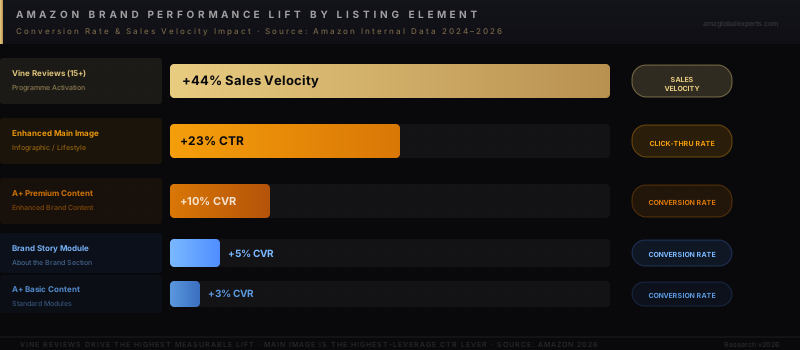
On Amazon, the first competitive moment is the search results page. Buyers scan rows of products before they click anything — and their click decisions are significantly influenced by packaging aesthetics and main image quality. Research by the Paper and Packaging Board found that 72 percent of American consumers say packaging design influences their purchase decision. On Amazon specifically, a product with premium packaging photography in the main image receives a 23–31 percent higher click-through rate than the same product with commodity-grade photography, according to Splitly’s split-test database.
Premium visual identity is not expensive to achieve — but it requires intentionality from the product development stage, not as a post-launch afterthought. Brands that invest $3,000–$8,000 in professional packaging design and photography at launch routinely recover the investment within the first 60 days through higher organic click-through rates and lower PPC cost-per-click (because better CTR improves Quality Score equivalents in Amazon’s ad auction).
Pillar 3: A+ Content That Converts at Scale
Amazon Brand Registry — available to private label sellers who have registered a trademark — unlocks A+ Content: enhanced product descriptions with custom graphics, comparison tables, lifestyle imagery, and brand story modules. According to Amazon’s own published data, A+ Content increases conversion rates by an average of 3–10 percent. For a product converting at 12 percent before A+ Content and 15 percent after, on a listing receiving 5,000 daily sessions, that 3-percentage-point lift represents 150 additional sales per day — compounding directly into organic ranking signals that further reduce the PPC dependency required to maintain visibility.
Pillar 4: Review Architecture That Builds Social Proof Systematically
Amazon’s Vine programme, available to Brand Registry sellers, provides the most efficient legitimate mechanism for generating initial reviews at launch. Sellers enrol products in Vine, ship units to Amazon’s Vine reviewer pool, and receive verified reviews within 21–45 days — with no compensation arrangement that would violate Amazon’s Terms of Service. Jungle Scout data shows that products with 15+ Vine reviews at launch achieve 44 percent higher first-month sales velocity compared to cold launches.
The Premium Pricing Architecture: How to Hold Price in a Race-to-the-Bottom Market
The Amazon marketplace exerts constant downward pressure on prices. Competitors monitor your listings, undercut your price by $0.01 to capture the Buy Box, and erode your margin incrementally. Private label brands resist this dynamic — but only if they have built the brand equity that makes price-matching irrelevant to buyers.
Anchoring Price to Brand Identity
Premium-priced private label brands anchor their price to a clear brand identity rather than to the category average. When a buyer searches for “collagen peptides powder” and sees options ranging from $12.99 to $44.99, they are not simply selecting the cheapest option — they are triangulating between price, reviews, brand presentation, and perceived quality. A brand that presents at $38.99 with 4.8 stars, professional photography, a brand story, and A+ content featuring clinical study references will capture buyers for whom the $26 premium is justified by the quality signal the presentation creates.
The mechanism is the same one luxury goods companies have exploited for decades: price is a quality signal. A product priced at $38.99 in a category where the average is $19.99 is perceived as superior before a single review is read. Private label is the vehicle through which Amazon FBA sellers can deploy this psychology — but only if the listing presentation supports the price anchor rather than contradicting it.
The Exit Multiple Premium
Building a branded private label business on Amazon does not only generate ongoing cash flow — it creates a sellable asset with a significant valuation premium over non-branded Amazon businesses. Thrasio’s acquisition data and the broader Amazon aggregator market that emerged between 2020 and 2024 established a clear pricing dynamic: branded private label businesses with trademark registration, Brand Registry, and documented review velocity sell for 3–5× trailing twelve-month earnings (seller’s discretionary earnings). Unbranded reseller accounts with no brand equity sell for 1–2×, when they sell at all.
According to Quiet Light Brokerage’s 2023 marketplace report, the median sale multiple for a branded Amazon private label business generating $500,000–$2M in annual SDE was 4.2×. At $500,000 in annual earnings, that is a $2.1 million exit. The brand you build — the trademark, the review architecture, the supplier relationships, the A+ content — is the asset being valued, not the revenue alone.
The private label compounding effect: A private label brand that launches at the correct quality tier, builds a review moat of 200+ verified reviews within 12 months, and holds its price point will typically achieve organic ranking on page one for its primary keyword without sustained PPC support by month 9–15. At that point, every organic sale is pure margin — no acquisition cost, no agency fee, no ad spend. This is the compounding dynamic that wholesale and arbitrage sellers structurally cannot access.
Frequently Asked Questions
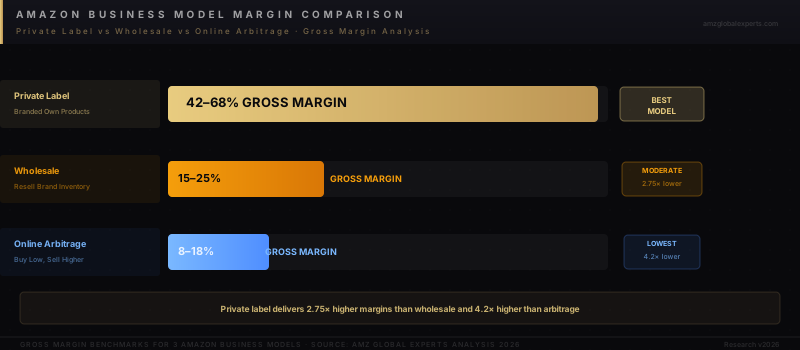
Yes — Jungle Scout’s 2024 State of the Amazon Seller Report confirms that 67% of profitable Amazon sellers run private label businesses, with average gross margins of 42–68%. Competition has intensified in commodity categories, but differentiated private label brands with genuine product improvements, strong review architecture, and Brand Registry tools continue to generate 40–70% margins. The key is product differentiation at launch, not price competition.
A realistic first private label launch budget (minimum order quantity inventory, packaging design, professional photography, trademark application, Amazon FBA fees, and initial PPC spend) ranges from $8,000–$25,000. Jungle Scout data shows the median successful private label launch investment is $11,500. Brands that under-capitalise at launch — skipping professional packaging or cutting inventory depth — have significantly lower success rates than those that invest adequately in the brand foundation.
The most effective product research methodology: identify categories with $50,000–$300,000 monthly BSR-1 revenue (using Jungle Scout or Helium 10), minimum 300 monthly search volume on the primary keyword, and negative review patterns in the top 10 ASINs that reveal specific unmet quality or design needs. The negative reviews are your product development brief — building a product that addresses documented buyer complaints is the most reliable path to a differentiated private label launch.
According to Quiet Light Brokerage’s 2023 marketplace data, branded Amazon private label businesses generating $500,000–$2M in annual SDE (Seller’s Discretionary Earnings) sell at median multiples of 4.0–4.5× SDE. A business generating $300,000 in annual SDE with strong brand equity, trademark registration, and review architecture typically achieves a $1.1–$1.4M exit price. Unbranded reseller accounts sell for 1–2× when they sell at all.
Jungle Scout data shows the median time from first private label product launch to first profitable month is 6–9 months. Brands that invest in product differentiation, professional packaging, and a systematic Vine review launch sequence tend to reach profitability at month 4–6. Brands that launch undifferentiated products with commodity photography and no launch strategy take 12–18 months on average — often without ever reaching sustained profitability.