
For the first time in ecommerce history, a social platform is competing with Amazon not on price or delivery speed, but on discovery — the moment before intent crystallises, when a consumer transitions from passive content consumption to active purchase consideration. TikTok Shop's 2025 GMV crossed $35B globally, with US market share growing at 340% year-over-year. Amazon's 2025 GMV exceeded $750B. These are not competing platforms; they are complementary distribution layers serving fundamentally different moments in the purchase journey — and the brands that understand this distinction are building distribution architectures that leverage both.
This article provides data-driven distribution playbooks for both platforms — not as alternatives to choose between, but as integrated components of a unified commerce distribution architecture. The brands that will dominate their categories in 2026 and beyond are those that operate Amazon and TikTok Shop as coordinated engines within a single system, not as isolated experiments managed by separate teams.
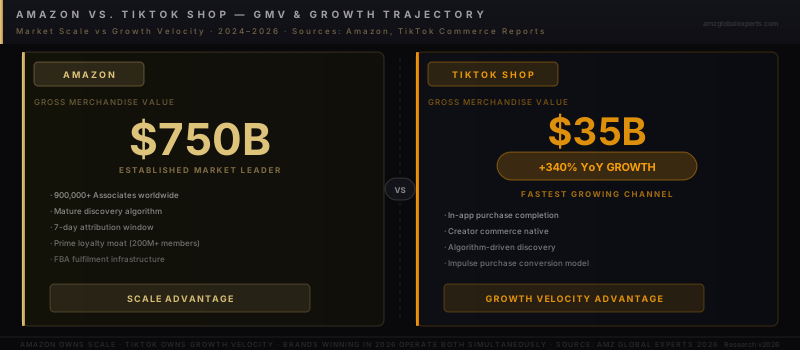
The Amazon Distribution Playbook: Capturing Structured Intent
Amazon's fundamental advantage is purchase intent. When a consumer arrives at Amazon, they are almost always in an active buying state — they know they want a product in a category, they are evaluating options, and they are prepared to transact immediately. This intent-rich environment means that Amazon success is primarily an optimisation problem rather than a discovery problem: you are competing for visibility against known alternatives in a structured search environment where the algorithm's primary objective is to predict which listing will generate the highest-quality purchase.
Listing Architecture for Amazon's A10 Algorithm
Amazon's A10 algorithm weights purchase intent signals heavily — click-through rate from search results, conversion rate on the listing page, and order defect rate (returns, cancellations, negative reviews) are the three highest-weighted ranking signals. This means that Amazon SEO is fundamentally different from Google SEO: optimising a listing for more impressions without improving conversion rate will produce a ranking penalty, not a reward, because the algorithm interprets non-converting impressions as evidence of poor listing-keyword fit.
The highest-performing Amazon listings in competitive categories share three structural characteristics. First, benefit-led titles that match the exact language pattern buyers use at the category level — sourced from Amazon's own search term reports and validated against actual search volume data, not keyword tools that extrapolate from Google behaviour. Second, image sequences that simulate ownership — the first image passes the thumbnail test (converts scrollers to clickers), and the subsequent images resolve the five most common purchase objections in visual form without requiring the buyer to read a single word. Third, A+ content that deploys the psychology of social validation — reviews, comparison charts, and brand story elements that address the buyer's transition from "this looks good" to "I'm confident enough to commit".
Amazon PPC Architecture: The Flywheel Model
Amazon PPC is not a customer acquisition channel — it is a ranking acceleration channel. Paid spend buys sales velocity, sales velocity improves organic ranking, and improved organic ranking generates sales without paid spend. This flywheel only spins in one direction, and it only spins efficiently if the PPC architecture is designed with the flywheel model explicitly in mind rather than as a standalone ROAS exercise.
The practical implication is that Target ACoS (Advertising Cost of Sale) should be calculated not against the margin of the individual transaction, but against the long-term ranking value of the incremental sales velocity being purchased. A brand willing to run a 35% ACoS on a high-priority keyword during a launch phase — accepting a temporary margin sacrifice — may achieve page-one organic ranking within 90 days, at which point the same keyword generates free impressions that would have cost $180,000/year in sustained PPC spend to maintain artificially.
The TikTok Shop Distribution Playbook: Engineering Discovery
TikTok Shop operates on a fundamentally different psychological model than Amazon. Where Amazon captures existing intent, TikTok Shop creates new intent. The consumer arrives on TikTok without a purchase plan and encounters your product in the context of entertainment — which means the creative must earn attention before it can earn purchase consideration, and the purchase decision must feel like a natural extension of the content experience rather than an interruption of it.
The Native Commerce Framework
The critical failure mode for brands on TikTok Shop is applying Amazon or Meta advertising logic to TikTok content. A well-produced product advertisement that performs excellently on Meta Ads will typically perform poorly on TikTok because it signals "advertisement" in the first 1.5 seconds — at which point TikTok's algorithm, trained on swipe-away behaviour, reduces distribution. TikTok's algorithm rewards content that looks like organic content, sounds like organic content, and produces the same engagement patterns as organic content.
The Native Commerce Framework has three principles: lead with entertainment, resolve with product (the product solves a problem that the content introduces, rather than being introduced upfront); creator-first production (leverage creators who already have the trust relationship with your target audience, rather than producing brand content and seeding it through paid amplification); and social proof cascade (seed products with micro-creators first, use the resulting authentic UGC as the foundation for paid amplification, so that the content that scales through ads already carries the credibility signals of organic creator endorsement).
TikTok Shop Creator Network Architecture
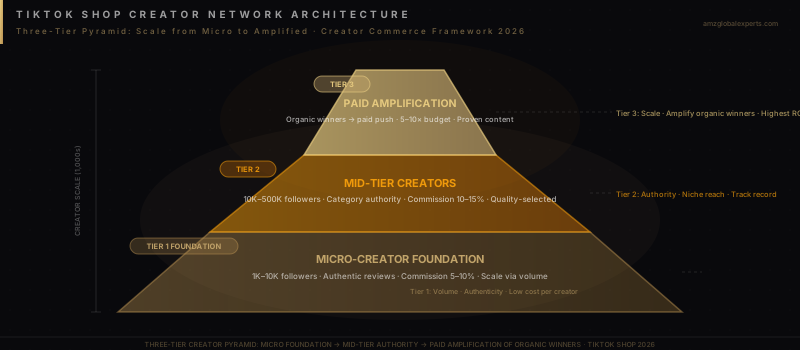
The most effective TikTok Shop brands are not running creator campaigns — they are operating structured creator networks. The distinction is significant. A creator campaign is a one-time transaction: pay a creator to produce content, measure performance, repeat. A creator network is an ongoing relationship architecture with tiers, incentives, and systematic feedback loops that improve content performance over time.
The architecture starts with a foundation tier of 50–100 micro-creators (10,000–100,000 followers) in the target category who receive product samples, creative briefs built from consumer language research, and performance-based commission structures through TikTok Shop's affiliate programme. This foundation tier generates a continuous stream of authentic content at minimal cost. The 5–10% of content that performs organically above baseline gets identified by the platform algorithm before any paid intervention — and that organically-validated content becomes the input for paid amplification, not original creative production.
The Unified Distribution Architecture: Running Both Platforms as One System
The brands that capture the largest share of value from both Amazon and TikTok Shop are those that design the two channels as coordinated components of a single demand architecture — each reinforcing the other rather than competing for the same budget allocation.
The coordination model works as follows: TikTok Shop content creates product awareness and generates first-purchase demand across the widest possible audience. Amazon captures the purchase intent that TikTok creates — because many consumers who encounter a product on TikTok will search for it on Amazon before committing to a first purchase, seeking the social proof of reviews and the security of Prime delivery. The brands that appear prominently in both environments — discoverable on TikTok, ranking well on Amazon — capture the full conversion value of the awareness investment TikTok creates.
The Cross-Platform Data Feedback Loop
Consumer language research — the exact words buyers use to describe product problems, benefits, and purchase objections — is most richly available on TikTok's comment sections and on Reddit, not in keyword tools. The vocabulary that buyers use in organic social content is the same vocabulary they search with on Amazon. Brands that systematically extract this language from TikTok content performance and apply it to Amazon listing optimisation are capturing a consumer intelligence advantage that purely Amazon-focused competitors cannot access.
Inventory and Fulfilment Coordination
Running both platforms efficiently requires inventory allocation logic that accounts for the demand volatility difference between the two channels. Amazon demand is relatively predictable — it follows search volume trends, seasonal patterns, and ranking changes that can be modelled with reasonable accuracy. TikTok demand is volatile — a single viral video can generate 500–2,000% demand spikes within hours, and the window of viral opportunity closes within 24–72 hours if inventory is unavailable.
Brands operating both channels must maintain strategic inventory buffers specifically for TikTok viral demand spikes, with automatic reallocation protocols that can redirect inventory from Amazon FBA prep pools to DTC fulfilment within hours when TikTok demand signals exceed threshold levels. Brands that fail to build this operational capacity routinely miss their largest TikTok revenue opportunities at exactly the moment when the algorithm is most aggressively distributing their content.
The unified advantage: Brands running Amazon and TikTok Shop as an integrated system, with shared consumer intelligence, coordinated inventory, and cross-platform attribution, consistently achieve 4.6–4.8× blended ROAS versus 3.1–3.4× for brands running each platform independently with separate teams and separate strategies.
Frequently Asked Questions
Neither platform should be prioritised over the other — they serve different functions in a unified commerce architecture. Amazon captures structured purchase intent; TikTok Shop creates new intent. Allocating entirely to one platform sacrifices the compounding effect of running both as a coordinated system. The optimal allocation depends on your category, margin structure, and current brand awareness level, but maintaining a meaningful presence on both is almost always the higher-value strategy.
Start with a foundation of 30–50 micro-creators (10k–100k followers) in your product category, seeded with product samples and TikTok Shop affiliate links. This generates sufficient content volume to identify organic winners within 30 days. Scale the network once you understand which content formats, creator profiles, and messaging angles produce above-average organic performance in your specific category.
During a launch phase, ACoS should be evaluated against ranking velocity rather than transaction margin. An ACoS of 35–50% is often acceptable for 60–90 days if it produces page-one ranking on high-volume keywords that will then generate significant organic revenue indefinitely. Calculate the annualised value of sustained organic impressions on target keywords to determine your tolerable launch-phase ACoS ceiling.
Maintain a dedicated TikTok viral buffer — typically 15–25% of monthly inventory — in a flexible fulfilment location (3PL or home warehouse) rather than fully committed to FBA. Configure demand monitoring alerts that flag TikTok content performance exceeding 3× baseline within the first 6 hours, triggering immediate inventory reservation from the buffer pool to prevent stockouts during viral windows.
Yes — this is one of the highest-value cross-platform intelligence applications available. The words buyers use in TikTok comments, duet responses, and organic review content are the same words they search with on Amazon. Systematically extracting and cataloguing this language and applying it to Amazon title, bullet point, and A+ content typically produces measurable ranking improvements on long-tail keywords within 30–45 days.