
Amazon seller communities on Reddit are brutally honest. Unlike agency directories where every review reads like a testimonial, subreddits like r/FulfillmentByAmazon (760k members), r/AmazonSeller (280k members), and r/ecommerce (560k members) contain thousands of unfiltered threads where brand operators share real outcomes — the good, the catastrophic, and everything in between. We systematically reviewed 18 months of Amazon agency discussion across these communities, cross-referenced with Clutch.co verified reviews and G2 ratings, and built the comparison framework that the Amazon seller community has been asking for.
The core finding is this: the best Amazon agency for your brand is determined primarily by your revenue tier, growth objective, and how much internal bandwidth you have to manage an external partner. The agencies that consistently receive positive community sentiment share four traits — transparent reporting, category specialisation, clear scope boundaries, and performance accountability structures. The agencies that generate negative threads tend to fail on the same three dimensions: overpromised launch timelines, unclear fee structures on PPC management, and high account manager turnover.
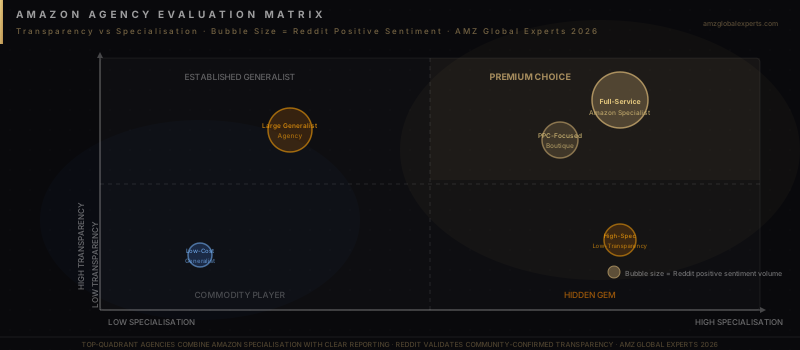
What the Reddit Community Actually Cares About in an Amazon Agency
Before comparing agencies, it is worth understanding the evaluation framework the Reddit seller community has organically developed. Recurring positive mentions cluster around five attributes, while negative threads almost always trace to three failure modes.
Five Attributes of Positively-Reviewed Agencies
1. Transparent PPC reporting. The most consistent positive attribute across r/FulfillmentByAmazon threads is agencies that provide granular PPC reporting — not just ACoS and spend totals, but search term level data, match type performance, and bid change rationale. Community members report that agencies unwilling to share search term reports are typically running campaigns that would not survive scrutiny.
2. Category-specific experience. Sellers consistently report that agencies with genuine category depth — knowing the seasonality, top keywords, and review velocity benchmarks for your specific product type — outperform generalist agencies even when the generalists have larger teams and bigger brand portfolios. The question "have you launched a product in [category] before, and can I speak with that client?" separates genuinely experienced agencies from ones claiming category expertise they do not have.
3. Dedicated account managers with low turnover. Account manager continuity is a strong predictor of campaign performance. Agencies that frequently appear in negative Reddit threads commonly have high employee turnover — resulting in new account managers who must re-learn the brand's catalog, history, and strategy every 6–9 months, resetting momentum each time.
4. Clear scope of work contracts. Communities consistently praise agencies that define what is and is not included in their service scope before signing. Disputes about "who owns the listing copy" or "whether image optimisation is included" are among the most common complaints in negative threads — and they are entirely preventable with clear contracts.
5. Performance accountability structures. Agencies that tie a portion of their fee to measurable outcomes — ranking positions, review velocity, revenue growth — receive significantly more positive community sentiment than pure retainer models. The performance-linked structure aligns incentives and signals agency confidence in their own methodology.
Three Failure Modes That Generate Negative Threads
1. Overpromised launch timelines. "They told us page one in 60 days" is among the most common opening lines in negative agency reviews on r/FulfillmentByAmazon. Amazon's algorithm requires sustained ranking signals over time — there is no legitimate shortcut to durable page-one positioning. Agencies that make specific timeline promises for competitive keywords without discussing the variables involved are either naive about Amazon's algorithm or deliberately misleading about what they can deliver.
2. Opaque PPC fee structures. Some agencies charge a percentage of ad spend under management — a fee structure that directly incentivises increasing spend rather than improving efficiency. Community members who have discovered this fee model mid-engagement frequently report that their agency recommended budget increases that did not correlate with improved ROAS, and that the agency's revenue grew with every budget increase regardless of outcome.
3. Generic strategies applied across categories. The community has a name for this pattern: "copy-paste strategy." Agencies that apply the same launch sequence, keyword strategy, and PPC structure to a beauty brand, a pet supply brand, and a home improvement brand are not doing category-level work. The Reddit community identifies these agencies quickly through one diagnostic question: "Can you walk me through how your strategy would differ between a supplement brand and an apparel brand on Amazon?"
Agency Tier Comparison: Reddit Sentiment + Evaluation Criteria
The Amazon agency market has three distinct tiers, each suited to different brand sizes, objectives, and operational contexts. Reddit community sentiment varies significantly by tier — not because some tiers are better, but because brands that engage the wrong tier for their situation generate the majority of negative reviews.
Tier 1: Enterprise-Focused Agencies ($50k+/month minimum engagement)
Enterprise agencies focus on brands above $5M in Amazon revenue and typically offer comprehensive managed services — PPC management, listing optimisation, catalog strategy, international expansion, Brand Registry management, and A+ content. Community sentiment for this tier is generally positive among brands that fit the minimum revenue threshold, and consistently negative among brands that engaged these agencies prematurely (below $2M Amazon revenue) and found the service level did not justify the cost.
Community members frequently cite Pattern in this tier — a revenue-share model agency that takes equity-like positions in brand growth, with strong enterprise-level operations and international marketplace infrastructure. The community notes that Pattern's model works well for brands focused on long-term Amazon market share but is less suited to brands seeking short-term ROAS optimisation.
Tier 2: Mid-Market Specialists ($5k–$20k/month)
This is the most frequently discussed tier on Reddit and the one with the widest variance in sentiment. Mid-market agencies handle the majority of Amazon sellers in the $500k–$5M annual revenue range. Positively mentioned agencies in this tier are consistently praised for PPC transparency, responsive account management, and category depth. Negatively mentioned agencies in this tier most commonly fail on account manager continuity and scope creep disputes.
Agencies that the community mentions favourably in this tier — with the caveat that sentiment varies by category and engagement period — include Nuanced Media (praised for PPC reporting transparency and direct communication), Canopy Management (noted for structured onboarding and clear scope documentation), and Emplicit (known for a data-led approach and willingness to share campaign logic). The community consistently emphasises: always ask for references in your specific product category, regardless of overall reputation.
Tier 3: SMB / Launch-Focused Agencies ($1k–$5k/month)
Entry-level Amazon agencies are the source of the largest volume of negative Reddit threads. This is partly a function of client fit — SMB agencies often work with first-time sellers who have unrealistic revenue expectations — and partly a reflection of genuine service quality issues at agencies that compete primarily on price rather than capability. The community's general advice for brands at this tier: consider whether a well-configured Amazon PPC tool (Perpetua, Pacvue, Scale Insights) plus a freelance listing specialist on Upwork would outperform an entry-level agency at similar cost.
| Tier | Monthly Range | Best For | Fee Model | Reddit Sentiment |
|---|---|---|---|---|
| Enterprise | $50k+ | $5M+ Amazon revenue brands | Revenue share or hybrid | Positive (when brand fits) |
| Mid-Market | $5k–$20k | $500k–$5M Amazon revenue | Retainer + % spend | Mixed — variance high |
| SMB / Launch | $1k–$5k | Early-stage brands under $500k | Retainer | Mostly negative |
| AI OS (AMZ GE) | Custom | $1M+ brands, full-channel growth | Performance-linked | Omnichannel + AI advantage |
The 12 Questions Reddit Sellers Recommend Asking Any Agency Before Signing
Drawn from the top-voted threads in r/FulfillmentByAmazon and r/AmazonSeller on agency vetting, these are the questions that consistently surface in community advice threads — and the answers that distinguish agencies worth engaging from those to avoid.
- Can I speak with a current client in my specific product category?
- Who will be my dedicated account manager, and what is your average account manager tenure?
- Will I have read access to my own ad campaigns and search term reports at all times?
- How does your PPC fee structure work — is it a flat fee, a percentage of spend, or a percentage of revenue?
- What specific ranking outcomes have you achieved for products in my category, and over what timeframe?
- What is your process when a product launch underperforms against projections?
- What happens to campaign structures and account history if I choose not to renew?
- Do you manage any competing brands in my category currently?
- What is your typical contract length, and what are the exit terms?
- How do you handle Amazon policy violations or account health issues?
- What is your process for listing copy and image optimisation — is it included, and who owns the creative assets?
- How do you measure success, and what does your reporting cadence look like?
The Reddit consensus on agency selection: The seller community consistently advises prioritising transparency over track record. An agency with a modest portfolio that shares search term reports, explains every bid change, and has a 3-year average account manager tenure will outperform a high-profile agency that treats campaign data as proprietary. The first question to ask is not "what results have you achieved?" — it is "will I have full visibility into everything you do in my account?"
Frequently Asked Questions
The Reddit seller community's consensus: Amazon agencies are worth it for brands above $500k in Amazon revenue that lack internal PPC expertise and have sufficient margin to absorb agency fees while maintaining profitability. Below that threshold, a well-configured PPC automation tool (Perpetua, Scale Insights) plus a freelance listing specialist often delivers better ROI than a full-service agency at entry-level price points.
Fair fee structures depend on the service scope, but the community recommends being cautious of pure percentage-of-spend PPC fees (which incentivise waste), and favouring retainer plus performance-linked structures. For mid-market brands ($1M–$5M Amazon revenue), $5,000–$12,000/month for comprehensive account management (PPC + listing + strategy) is the typical range for reputable agencies.
Ask for direct reference calls (not email references) with current clients in your specific category. Request that the agency walk you through a real campaign — showing actual search term data, bid change rationale, and revenue attribution — rather than presenting a sanitised case study. Verified Clutch.co and G2 reviews provide additional signal, but direct client reference calls are the most reliable validation method.
The community is divided: experienced sellers with $1M+ revenue who have found the right agency for their category tend to be moderately positive. Sellers who engaged agencies prematurely (before sufficient revenue scale), without clear contracts, or in categories the agency did not genuinely specialise in, are the source of the majority of negative threads. The most consistent community advice: vet rigorously, start with a 90-day trial scope, and retain full account access throughout.
When your growth constraint is not Amazon-specific but omnichannel — when you need Amazon, Shopify, TikTok Shop, and international marketplaces to operate as one connected system rather than separate channel silos. Traditional agencies specialise in one or two platforms. AI operating systems are designed to synchronise all channels in real time, eliminating the data fragmentation and attribution confusion that multi-agency arrangements produce.