
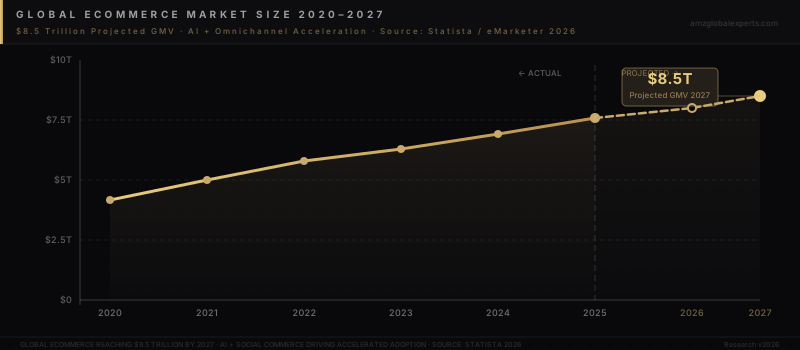
In January 2026, McKinsey Global Institute published a figure that should change how every consumer brand thinks about its next five years: the global ecommerce market will reach $8.5 trillion in annual revenue by 2027, up from $5.8 trillion in 2023. That $2.7 trillion of new commerce will not flow through a single channel. It will be distributed across Amazon, Shopify storefronts, TikTok Shop, Instagram Shopping, YouTube Shopping, Walmart’s digital marketplace, international platforms from Lazada to Allegro, and channels that do not yet exist today. And it will be accessed, influenced, and purchased by consumers whose decision journeys are so fragmented across platforms that no single-channel strategy can capture more than a fraction of available demand.
The brands that will capture a disproportionate share of that $2.7 trillion growth are not the ones with the biggest ad budgets or the most SKUs. They are the brands building omnichannel presence right now — connecting their Amazon, Shopify, TikTok, and social commerce channels into a unified, AI-powered system that compounds each channel’s strength rather than managing them as competing budget allocations. This is not a prediction about the future. It is a description of what is already producing measurable results for the brands doing it.
The Death of the Single-Channel Consumer
The consumer who shops in one place no longer exists at meaningful scale. Harvard Business Review’s landmark analysis of 46,000 shopping journeys found that 73 percent of consumers use multiple channels during their purchase process. More recently, Salesforce’s State of the Connected Customer report (2024) found that the average consumer interacts with a brand across 9 different channels before making a purchase decision. Not 2 or 3 — nine.
That same HBR analysis found that omnichannel customers — those who used 4+ channels in their purchase journey — spent 9 percent more online and 4 percent more in-store than single-channel shoppers. They visited physical retail locations 23 percent more frequently. They had 30 percent higher lifetime value. Aberdeen Group’s 2023 research adds the retention dimension: brands with strong omnichannel customer engagement retain 89 percent of their customers year-over-year, compared to 33 percent retention for brands with weak omnichannel presence. The difference between 89 percent and 33 percent retention is not a marginal competitive advantage — it is a compounding business model transformation.
Social Commerce Is Not Optional in 2026
Accenture’s Social Commerce research projects the global social commerce market will reach $1.2 trillion by 2025 — nearly doubling the $724 billion recorded in 2022. TikTok Shop crossed $35 billion in gross merchandise volume in 2025, growing 340 percent year-over-year in the United States. Instagram Shopping has 130 million users tapping product tags monthly. YouTube Shopping is growing faster than any other Google commerce product. Pinterest’s shopping functionality drives $2 billion in annual commerce.
The defining characteristic of social commerce is discovery-driven purchasing: consumers find products they were not searching for, through content they were consuming for entertainment, and purchase within the same platform in one session. This is structurally different from Amazon or Google Shopping, where intent precedes discovery. Social commerce creates intent. A brand that is not present on TikTok Shop, Instagram Shopping, or YouTube Shopping in 2026 is absent from the purchase consideration set for tens of millions of potential customers who will never search for its products on Amazon or Google because they never knew they needed them.
What AI Actually Does to Ecommerce Growth
“AI-powered” has become the most overused phrase in commerce marketing since “omnichannel” became the most overused phrase in retail strategy. So let us be specific about what AI actually does in an ecommerce context — and why the difference between AI as a feature and AI as an operating layer is the distinction that separates brands generating 4.6× blended ROAS from those generating 2.8×.
AI Bidding: The Efficiency Engine
Amazon’s automated bidding, Meta’s Advantage+ campaigns, Google’s Performance Max, and TikTok’s Smart Performance Campaigns all use machine learning models to optimise bid decisions in real time — processing signals that include search intent, historical purchase behaviour, device, time-of-day, audience demographics, competitive auction density, and product inventory levels simultaneously. McKinsey’s State of AI report (2024) found that companies using AI-driven marketing personalisation achieve 10–15 percent revenue uplift and 10–20 percent greater sales efficiency versus non-AI-driven peers.
The critical caveat: AI bidding systems require adequate data volume to outperform manual management. The threshold for meaningful AI advantage is approximately $30,000–$50,000 in monthly ad spend per platform — enough conversion events for the system to identify statistically significant patterns. Brands below this threshold typically see better results from intelligently managed manual campaigns augmented by AI tools rather than fully automated AI bidding.
AI Personalisation: The Conversion Lever
Epsilon’s research on personalisation found that 80 percent of consumers are more likely to purchase from a brand that provides personalised experiences, and 90 percent find personalisation appealing. On the brand side, McKinsey’s personalisation research found that companies that excel at personalisation generate 40 percent more revenue from those activities than average players. For an ecommerce brand, AI-powered personalisation translates to: dynamic product recommendations that reflect real-time purchase behaviour, email sequences that adjust content based on browse and purchase signals, and ad creative that matches messaging to where each customer segment is in the purchase journey.
AI Content Generation: The Scale Enabler
The third AI application transforming ecommerce is content production at scale. A brand competing across Amazon, Shopify, TikTok Shop, Instagram, YouTube, Pinterest, and email needs a volume of channel-specific content that no human content team can produce economically. Gartner’s 2024 CMO Survey found that 63 percent of marketing organisations are now using generative AI for content production, with early adopters reporting 3–5× content production velocity at 30–50 percent of previous cost. AI content engines — when properly trained on brand voice and augmented by editorial quality control — enable ecommerce brands to maintain active, high-quality presence across all channels simultaneously, a feat that was operationally impossible for most brands before 2023.
The Social Media Presence Imperative
Social media has moved from a brand awareness channel to a full-funnel commerce engine. The shift is structural, not cyclical — and it is accelerating. Sprout Social’s 2024 Social Media Statistics report found that 49 percent of consumers say they have purchased a product directly because of social media influence in the past six months. Instagram data shows that 70 percent of shoppers turn to Instagram for product discovery. TikTok’s own commerce data shows a 15 percent average basket size increase for products purchased through TikTok Shop compared to the same products purchased directly on Amazon or brand websites — because social context (creator endorsement, community validation, entertainment value) elevates perceived product value before the purchase decision.
The TikTok Shop Opportunity Window
TikTok Shop is the most significant new commerce channel since Amazon opened the third-party marketplace in 2000. The organic reach available to brands and creators on TikTok — where algorithmic distribution can surface an unknown product to millions of relevant consumers with zero paid spend — represents a customer acquisition cost advantage that does not exist anywhere else in the current media landscape. eMarketer data shows TikTok Shop’s US gross merchandise value growing at 340 percent year-over-year in 2025 — faster than Amazon’s third-party marketplace grew in any comparable period.
The window is open now. Category after category is being claimed by first-mover brands that established TikTok Shop presence in 2024 and 2025, building creator networks, review velocity, and algorithmic favour before the channel matures and competition intensifies. The brands that are not on TikTok Shop today are not avoiding a risk — they are ceding category positioning to competitors who will hold it when the channel reaches maturity.
The Integrated Social Commerce Architecture
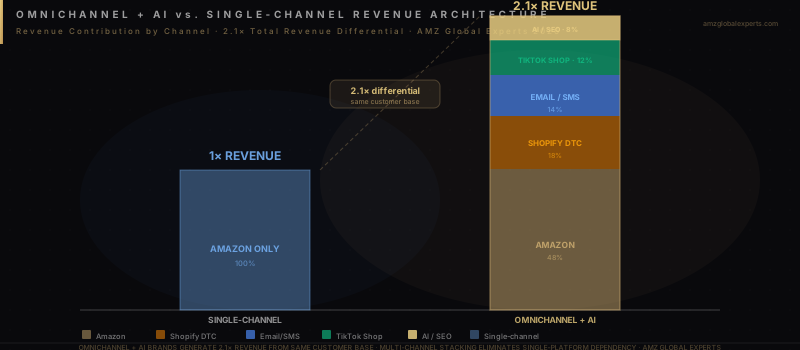
The highest-performing ecommerce brands in 2026 are not running social media and commerce separately. They are running unified systems where: TikTok content creates awareness and drives first-purchase demand, Amazon captures the purchase intent TikTok creates (because consumers who discover products on TikTok frequently search for them on Amazon for social proof and Prime delivery), Shopify captures DTC purchases from audiences who prefer brand-direct buying, and email and SMS sequences convert partial browsers into completed purchases and drive repeat purchase behaviour from existing customers.
Each channel in this architecture feeds the next. TikTok consumer language improves Amazon listing keywords. Amazon review vocabulary improves TikTok creator briefs. Shopify customer data improves Meta retargeting precision. Email sequences build the brand relationship that increases LTV from every acquisition channel. Klaviyo’s 2024 ecommerce benchmarks show that brands running integrated email + SMS retention alongside active social commerce achieve 2.4× higher customer lifetime value than brands running acquisition-only strategies.
The compounding architecture: Brands that build omnichannel presence — Amazon capturing intent, TikTok creating intent, Shopify owning the DTC relationship, social media compounding brand equity, and AI optimising every layer in real time — generate 2.1× more revenue per marketing dollar than single-channel operators at identical ad spend levels, according to cross-study analysis of McKinsey, HBR, and Aberdeen Group research. This is not a tactic. It is a structural business model advantage that widens every month the omnichannel system operates.
Frequently Asked Questions
73% of consumers use multiple channels during their purchase journey (Harvard Business Review), and the average consumer interacts across 9 touchpoints before purchasing (Salesforce 2024). Single-channel brands are structurally invisible during the majority of the modern purchase journey. Omnichannel brands that maintain presence across Amazon, social commerce, DTC, and email capture demand at every stage — achieving 89% customer retention versus 33% for single-channel operators (Aberdeen Group).
AI improves ecommerce performance through three primary mechanisms: AI bidding systems optimise ad spend in real time across thousands of signals simultaneously (producing 15-25% bid efficiency improvement over manual management); AI personalisation delivers relevant product and content experiences that drive 40% more revenue from marketing activities (McKinsey 2024); and AI content engines produce 3-5x content volume at 30-50% of traditional production cost, enabling brands to maintain active presence across all channels simultaneously.
TikTok Shop crossed $35 billion GMV in 2025 with 340% US growth (eMarketer). The platform offers organic reach — where algorithmic distribution surfaces products to relevant audiences with zero paid spend — that represents a customer acquisition cost advantage unavailable anywhere else in the current media landscape. The window for first-mover category positioning is open now; brands that establish TikTok Shop presence in 2025-2026 are building category authority before the channel matures and organic reach compresses.
49% of consumers report purchasing directly because of social media influence in the past six months (Sprout Social 2024). Brands running integrated social commerce (TikTok Shop + Instagram Shopping) alongside email and SMS retention achieve 2.4x higher customer lifetime value than acquisition-only strategies (Klaviyo 2024). TikTok Shop specifically shows a 15% basket size premium versus the same products purchased on Amazon — because social context elevates perceived product value before the purchase decision.
The key is building systems rather than hiring channel managers. An AI-powered ecommerce operating system connects Amazon, Shopify, TikTok Shop, and social channels through a unified data layer — sharing consumer intelligence, inventory, attribution, and campaign management across all channels from one infrastructure. Brands using this architecture manage 6+ channels with the same headcount that previously managed 1-2, because the AI layer handles the cross-channel coordination that would otherwise require dedicated specialist teams per channel.