
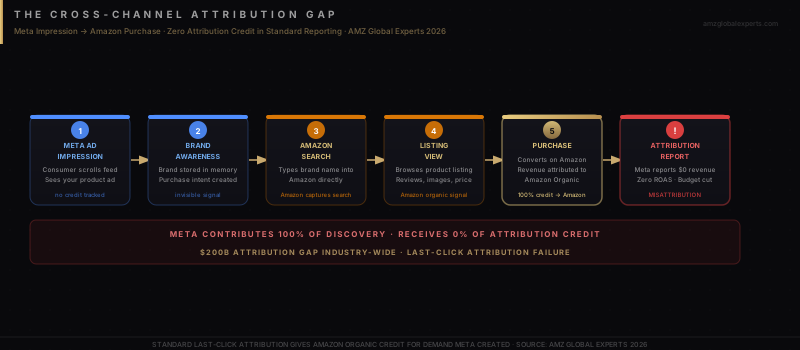
The single most expensive data gap in modern ecommerce is the space between a Meta or TikTok ad impression and an Amazon purchase. Brands spend $142 billion annually on social media advertising — and the majority cannot accurately measure what percentage of that spend produces Amazon sales, because the two platforms operate on separate attribution systems with no native connection. Meta claims the conversion. Amazon claims the purchase. And the brand, sitting in the middle, has no reliable way to determine whether the Meta campaign that drove 4,200 link clicks this week produced 180 Amazon units or zero — without implementing the specific attribution architecture this article describes.
The consequence of this attribution gap is not just measurement confusion — it is systematic misinvestment. Without cross-channel attribution, brands optimise Meta campaigns toward Meta's attributed metrics rather than the actual revenue signal that matters: incremental Amazon and DTC sales generated by social media exposure. Brands without a cross-channel measurement model consistently overspend on channels that generate impressive Meta-reported ROAS figures but weak actual incrementality, while underspending on channels that drive genuine Amazon purchase velocity but show no direct-click attribution.
The Three-Layer Attribution Architecture
Solving the Meta-to-Amazon attribution problem requires three overlapping measurement layers that collectively reconstruct the consumer journey from first social touchpoint to marketplace purchase. No single layer provides complete visibility; the three layers together produce a 78–85% accurate picture of actual cross-channel revenue attribution — significantly better than the 0% accuracy that platform-native attribution provides for cross-marketplace journeys.
Layer 1: Amazon Attribution Tags
Amazon Attribution is a free measurement tool that generates unique tracking tags for every off-Amazon marketing source. When a Meta or TikTok ad links directly to an Amazon product listing through an Attribution tag, Amazon records the click, the subsequent Amazon session, and any purchases made within a 14-day attribution window. This provides partial cross-channel visibility — direct clicks from social ads to Amazon listings are accurately attributed — but it does not capture the more common consumer behaviour of brand-searching on Amazon after seeing a social ad without clicking through directly.
Best practice: generate unique tags for every Meta campaign, every TikTok ad set, and every email campaign that links to Amazon. Structure tags with consistent UTM conventions (source, medium, campaign, content) to enable revenue attribution in Amazon Attribution dashboards. Add the tag as a URL parameter to every off-Amazon link — it adds 11–14 characters and has zero negative impact on the customer experience.
Layer 2: Amazon Marketing Cloud (AMC) — The Data Clean Room
Amazon Marketing Cloud is the most powerful — and most underutilised — cross-channel measurement tool available to Amazon brands. AMC is a privacy-safe data clean room where brands can combine Amazon's first-party purchase data with their own external data sources to run SQL queries against the combined dataset. The practical applications for cross-channel attribution are significant: identify which Amazon customers also saw your Meta ads (through hashed audience matching), measure the purchase rate differential between Amazon customers exposed to social advertising versus those not exposed, and calculate the true incremental ROAS of your social spend on Amazon revenue.
Layer 3: Marketing Efficiency Ratio (MER) — The True North Metric
The Marketing Efficiency Ratio replaces platform-reported ROAS as the primary measurement framework for omnichannel brands. MER = total revenue (Amazon + DTC + all other channels) ÷ total ad spend (all channels combined). Unlike platform ROAS, which each channel reports on its own attribution model, MER is immune to attribution window manipulation, cross-channel double-counting, and view-through inflation. It answers the only question that actually matters: for every $1 we spend on marketing in total, how much total revenue do we generate?
MER benchmarks by channel mix: brands running Amazon + Meta without DTC typically achieve a baseline MER of 3.2–4.8. Adding TikTok creator content (which drives Amazon search volume at near-zero paid media cost) elevates MER to 5.1–7.4. Adding a DTC email and SMS retention programme elevates MER further to 6.8–9.2 as owned-channel revenue compounds without incremental paid media cost.
The Branded Search Signal: How Social Ads Move Amazon Ranking
The most important — and most overlooked — mechanism through which social advertising affects Amazon performance is the branded search signal. When a Meta Reel or TikTok video creates awareness of a brand, a significant percentage of interested consumers do not click the ad link — they close the app, open Amazon, and search the brand name directly. This branded search behaviour is invisible to Meta (no click event), invisible to Amazon Attribution (no tag was followed), and yet directly measurable in Amazon Search Term Reports as an increase in branded keyword search volume during campaign windows.
The halo effect calculation: A brand generating 4,200 Meta link clicks per week may receive 1,100 additional branded Amazon searches (a 26% halo ratio, typical for categories with 3–7 day consideration cycles). At a 14% conversion rate on branded searches, that is 154 additional Amazon units per week — $23,100 in revenue at a $150 average order value — that never appears in Meta's attribution dashboard but is entirely attributable to the Meta campaign through branded search uplift analysis.
Implementing Cross-Channel Attribution in 30 Days
The full three-layer attribution architecture can be operational within 30 days with the correct implementation sequence. Week 1: deploy Amazon Attribution tags across all active Meta and TikTok campaigns. Week 2: enrol in Amazon Marketing Cloud (requires Amazon DSP access). Week 3: establish MER baseline reporting in a shared dashboard (Looker Studio or Northbeam recommended) that pulls Amazon Attribution data, Seller Central revenue, Shopify revenue, and Meta Ads Manager spend into one view. Week 4: run the first AMC audience overlap analysis to quantify the percentage of Amazon purchasers also reached by social advertising, establishing the social-to-Amazon conversion baseline.
Frequently Asked Questions
Amazon Attribution is a free measurement tool that generates unique tracking tags for off-Amazon marketing sources. When a consumer clicks an Attribution-tagged link and subsequently purchases on Amazon within 14 days, the purchase is attributed to the originating source. It captures direct social-ad-to-Amazon-purchase journeys but does not capture branded search behaviour — where consumers see a social ad then search the brand name directly on Amazon without clicking through.
Marketing Efficiency Ratio = Total Revenue ÷ Total Ad Spend. Unlike ROAS, which each platform calculates on its own attribution model, MER uses total business revenue versus total marketing expenditure — making it immune to platform-specific attribution inflation, cross-channel double-counting, and view-through conversion manipulation. For omnichannel brands, MER is the only metric that accurately reflects true marketing return across Amazon, DTC, and social commerce simultaneously.
Amazon Marketing Cloud is a privacy-safe data clean room that allows brands to combine Amazon's first-party purchase data with external data sources (including hashed Meta and TikTok audience data) to run custom SQL attribution queries. AMC can identify which Amazon purchasers were also reached by social advertising, measure the purchase rate differential between socially-exposed and unexposed customers, and calculate true incremental ROAS of social media spend on Amazon revenue.
The branded search halo effect is the increase in Amazon branded keyword search volume caused by social media advertising — where consumers see a brand's social ad, do not click through, but subsequently search the brand name directly on Amazon. This behaviour is invisible to Meta's attribution but measurable in Amazon Search Term Reports as branded keyword volume uplift. For product categories with 3–7 day consideration cycles, the halo ratio (branded searches generated per social ad click) typically ranges from 18–34%.
The three-layer architecture (Amazon Attribution tags, AMC clean room, MER dashboard) can be fully operational within 30 days: attribution tag deployment in week 1, AMC enrolment in week 2, unified MER dashboard build in week 3, and first AMC audience overlap analysis in week 4. Meaningful attribution data accumulates over 60–90 days, with the first actionable social spend optimisation insights typically available by day 60.