The creator economy generated $250 billion in global economic value in 2024 (Goldman Sachs). For ecommerce brands, the strategic opportunity is not running influencer campaigns — it is building a systematic content infrastructure where creator-generated content simultaneously drives TikTok Shop discovery, fuels Amazon listing conversion, and provides paid social creative that performs at 2–4× the click-through rate of brand-produced alternatives. Brands executing this correctly generate $50,000–$300,000 per month in directly attributable creator-driven revenue from a network of 50–150 micro-creators who earn affiliate commission rather than upfront fees.
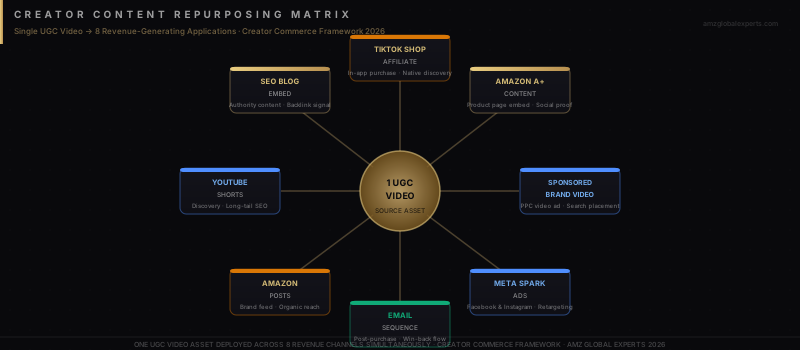
The distinction between brands running creator campaigns and brands running creator systems is where the compounding begins. A campaign produces a spike. A system produces a compounding content library: every piece of creator content that performs above baseline is repurposed into Amazon listing images, A+ Content modules, Sponsored Brand Video ads, email sequences, and landing page assets. The same 60-second TikTok video becomes eight distinct marketing assets across five channels. This is content infrastructure — and it changes the economics of ecommerce brand building at a fundamental level.
Why UGC Outperforms Brand-Produced Creative in 2026
TikTok's algorithm prioritises authenticity signals over production quality — a reality that extends beyond TikTok to the full modern commerce landscape. Meta's ad auction weights content that generates native interaction (comments, shares, saves) over passive impressions. Amazon's A+ Content modules featuring real-customer lifestyle photography consistently achieve 3–5% higher add-to-cart rates than studio photography. Amazon Posts — the native social feed inside the marketplace — surfaces UGC-style content to shoppers browsing category pages at zero incremental cost.
Creator content does not just drive discovery — it functions as social proof that removes purchase hesitation at every point in the funnel. A consumer seeing a product on TikTok Shop arrives at the Amazon listing already half-decided. The combination of TikTok social proof plus Amazon listing trust signals (reviews, A+ Content, Brand Story) produces conversion rates that neither channel achieves independently.
Building Your Creator Network: The 90-Day Architecture
Phase 1: Creator Seeding (Days 1–30)
The first 30 days are not about generating revenue — they are about generating content signals. Seed your product with 30–50 micro-creators (10,000–100,000 followers) in your category and collect the organic content they produce. Do not brief creators with rigid scripts. Provide a clear product positioning document, three suggested use cases, and an affiliate link. The organic language creators use to describe your product — when it converts — is more valuable than any copy your marketing team writes, because it reflects how real consumers actually talk about the category.
Source creators through three channels: TikTok Creator Marketplace (filter by category, engagement rate above 4.5%, and audience location); affiliate programmes of competing brands (where creators already produce content in your category); and direct outreach to creators who have posted organically about your category. The third source consistently produces the highest-quality content because these creators have existing audience trust in the space.
Phase 2: Signal Amplification (Days 31–60)
By day 30, you will have 30–100 pieces of creator content in market. Most will generate modest performance — 1,000–5,000 organic views. A meaningful minority (typically 10–15% of a well-targeted creator pool) will exceed 3× category average engagement. Convert high-performing organic content into TikTok Spark Ads using the creator's original post as the ad unit. Spark Ads that amplify existing organic content outperform equivalent brand-produced TikTok video ads by 2.1× on cost-per-click, because they inherit the social proof signals (comments, shares, saves) of the original post.
Phase 3: Amazon Integration (Days 61–90)
Extract the consumer language, use cases, and objection handling from your top 10 performing creator videos. Apply this language directly to your Amazon listing title, bullet points, and A+ Content. Brands that apply TikTok creator vocabulary to Amazon listings see 15–22% improvement in long-tail keyword ranking within 45 days, because the language consumers use on TikTok mirrors the search terms they use on Amazon. Top creator content also converts directly into Amazon Posts format (mobile portrait crop, text overlay), driving zero-cost impressions on category browse pages.
The Affiliate Architecture: Scaling Without Upfront Cost
Affiliate-based creator networks align incentives: creators earn commission on sales they drive, giving them direct financial motivation to produce content that converts rather than content that generates passive impressions. This shifts creator expenditure from a fixed upfront cost to a variable performance cost — every dollar spent directly corresponds to revenue generated.
Commission Structures That Attract and Retain Quality Creators
The commission rate that attracts genuine micro-creators in the current market is 15–20% of the sale price for products under $100, and 10–12% for products above $100. Rates below 12% on sub-$100 products consistently result in creator churn after the seeding phase. An additional 5% performance bonus for creators driving more than $2,000/month in attributed sales provides a retention incentive that costs nothing unless the creator is already generating significant revenue.
The creator network compounding effect: A 50-creator affiliate network producing an average $400/month each generates $20,000/month in creator-driven revenue at a 17% commission cost — or $3,400. The same $3,400 in Meta advertising generates $14,000–$18,000 in revenue (at 4.1–5.3× ROAS). The creator network matches paid media performance — and the content library it produces feeds paid media creative for the next 6–12 months.
Amazon-Specific Creator Integrations
Amazon Vine + Creator Seeding Sequence
For new product launches, combine Amazon Vine (for verified-purchase review velocity in weeks 1–4) with creator seeding (for social proof content in weeks 2–8). Vine produces the initial review foundation that makes the Amazon listing credible to first-time visitors. Creator content provides the discovery mechanism that drives those visitors to the listing. Running them concurrently produces 38% faster time to first page-one keyword ranking than Vine alone, because external traffic from TikTok clicks elevates Amazon's perception of the product's relevance.
Amazon Inspire Feed Integration
Amazon's Inspire feed (TikTok-style vertical scroll inside the Amazon app) surfaces creator content from brands enrolled in the Amazon Creator Connections programme. Brands actively feeding creator content into Inspire generate 8–14% of their total Amazon traffic from the feed at zero advertising cost. The feed prioritises video content between 15 and 60 seconds with a minimum 3.5% engagement rate — the same specifications that perform on TikTok, meaning your TikTok creator content can be repurposed directly into Inspire without additional production.
Frequently Asked Questions
Start with 30–50 micro-creators (10,000–100,000 followers) seeded with product and affiliate links. This generates enough content volume to identify which creators and formats perform above baseline in your category, without overspending on creators whose audience doesn't convert for your product.
15–20% for products under $100, and 10–12% for products above $100. Rates below 12% on sub-$100 products consistently produce creator churn after the initial seeding phase. Add a 5% performance bonus for creators generating more than $2,000/month in attributed sales to drive retention of your top performers.
UGC improves Amazon conversion through two mechanisms: consumer language extracted from high-performing creator content directly improves long-tail keyword ranking (15–22% improvement in 45 days), and UGC-derived lifestyle imagery in A+ Content achieves 3–5% higher add-to-cart rates than studio photography, because it functions as visual social proof rather than product documentation.
A creator campaign produces a content spike during a specific window and then the output depreciates. A creator system produces a compounding content library: high-performing creator videos are repurposed into Amazon listing assets, TikTok Spark Ads, Meta ad creative, email imagery, and Amazon Posts — multiplying each creator's output across eight channels and building an asset library that improves marketing performance for 12–18 months.
Yes — with creator permission (captured in your affiliate agreement). UGC-derived Sponsored Brand Video ads consistently outperform brand-produced equivalents on Amazon by 2.3–3.1× click-through rate, because the authentic social proof aesthetic generates higher relevance signals in Amazon's ad auction. Content must meet Amazon's specifications (15–30 seconds, 1920×1080) but should preserve the authentic creator feel.